
Kartik Purnima 2026: Dev Deepawali, Guru Nanak Jayanti
कार्तिक पूर्णिमा 2026 — 24 नवंबर, मंगलवार को देव दीपावली और गुरु नानक जयंती।
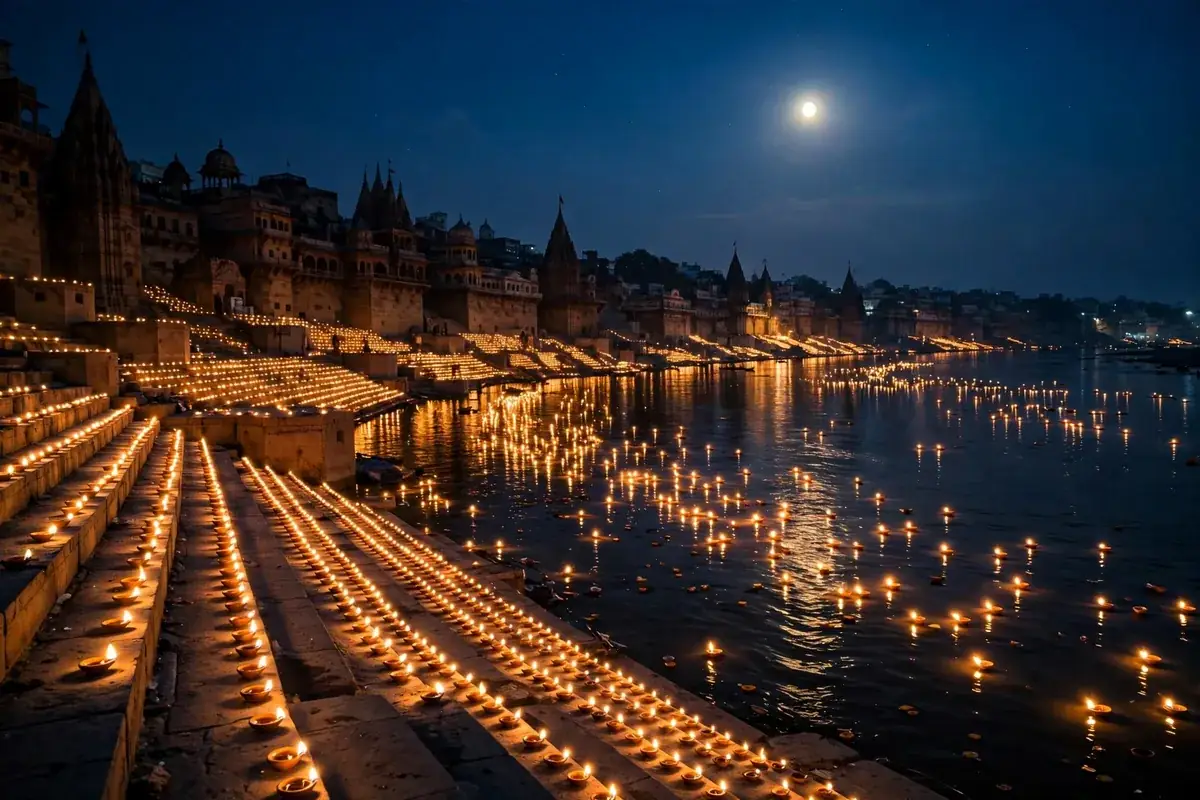
Kartik Purnima 2026 falls on Tuesday, 24 November 2026. The Purnima tithi begins at 11:42 PM on Monday, 23 November and ends at 8:23 PM on Tuesday, 24 November (IST, New Delhi reference). Because the tithi covers sunrise on the 24th, that is the day of the vrat, the snan and the evening lamps. It is the full moon that closes the holy month of Kartik, and it carries three festivals at once: Dev Deepawali in Varanasi, Guru Nanak Jayanti, and the Kartik Snan with Satyanarayan Katha. Moonrise is about 5:00 PM in Delhi, and it varies by city. This article gives the timings, the three traditions behind the day, and what families actually do on it — written as traditional practice, not as a promise of any result.
Kartik Purnima 2026 date and tithi
The rule that fixes the date is the udaya tithi: the tithi in force at sunrise is the tithi of the day. Purnima begins late on the night of 23 November and is still running at sunrise on 24 November, so the observance belongs to the 24th. The tithi ends at 8:23 PM that evening, which is why the lamps of Dev Deepawali are lit on the 24th while Purnima still holds.
| Timing | Date and time (IST) |
|---|---|
| Purnima tithi begins | 11:42 PM, Mon 23 November 2026 |
| Purnima tithi ends | 8:23 PM, Tue 24 November 2026 |
| Kartik Purnima (observed) | Tuesday, 24 November 2026 |
| Sunrise, New Delhi | 6:50 AM, 24 November |
| Sunset, New Delhi | 5:24 PM, 24 November |
| Moonrise, New Delhi | About 5:00 PM, 24 November |
| Nakshatra | Krittika, until about 11:25 PM on 24 November |
| Pradosh kaal (twilight window) | Evening after sunset; Ujjain ref. 5:40–8:17 PM, Delhi sunset 5:24 PM |
Tithi start and end times are the same across India; sunrise, sunset and moonrise shift by a few minutes from city to city. In Ujjain, for example, moonrise is listed at 5:15 PM. If you plan an arghya or a lamp-lighting at a precise minute, check your own city's panchang — the table above uses the New Delhi reference unless stated.
Why this Purnima is called Tripuri Purnima
Kartik Purnima is also called Tripuri Purnima, and the name comes from a story in the tradition. Shiva, as Tripurantaka, is said to have destroyed the three cities (Tripura) of the asuras on this full moon night. The lamps lit on Kartik Purnima are read in the tradition as a celebration of that victory of light — which is also why the same night is kept as Dev Deepawali, the Diwali of the gods. The story is told as tradition, not as history, and the lamps are the part of it that people can see: homes, temples and riverbanks are lit on this night across India.
The month itself is named for the nakshatra. The full moon of Kartik falls in Krittika, the nakshatra the month is named after, and in 2026 the Moon is in Krittika until about 11:25 PM on the 24th. In the Purnimanta calendar followed in North India, the month of Kartik ends on this Purnima. It is the month of lamps — deepam is lit through the month, and the Purnima is its closing night.
Dev Deepawali in Varanasi
Dev Deepawali is the grandest form of the day, and its home is Varanasi. On Kartik Purnima evening, the ghats of the Ganga are lit with lakhs of earthen lamps, the Ganga aarti is performed, and the river is read in the tradition as the place where the gods themselves come to bathe on this night. That is the meaning of the name: Dev Deepawali, the Diwali of the gods.
The celebration is real and annual — Varanasi's ghats, from Assi to Rajghat, are lined with diyas, and the evening aarti draws crowds from across the country. For families at home, the practice is smaller and the same in spirit: lamps are lit at the door, in the temple room and at the tulsi, and a lamp is offered to the river or to a water body where one is near. The lamp-lighting window is the evening, after sunset, during Pradosh kaal (the daily twilight window) — the table above gives the Ujjain reference of 5:40 PM to 8:17 PM, with Delhi sunset at 5:24 PM, so the local window is what a family follows in its own city.
If you are not in Varanasi, nothing is lost by lighting lamps at home. The tradition ties the merit to the lamp and the intention, not to the city, and most families observing Kartik Purnima do it at home: a row of diyas at the entrance, one before the tulsi, and one floated on water where that is possible.
Guru Nanak Jayanti on the same day
The same full moon is also Guru Nanak Jayanti — the birth anniversary of Guru Nanak, the founder of Sikhism. In 2026 it is the 557th birth anniversary (Guru Nanak was born in 1469). Gurdwaras hold kirtan through the day, langar is served to all, and the day is kept as Gurpurab across Punjab and in Sikh communities everywhere.
Guru Nanak Jayanti is kept on Kartik Purnima itself, so the two fall together every year — observed separately, by different communities, on the same full moon. In cities like Amritsar and Varanasi both are visible on the same evening: lamps on the ghats and kirtan in the gurdwaras. For a family keeping Kartik Purnima, the practical note is simple: the day is crowded, temples and gurdwaras are both busy, and the evening is best planned early.
Kartik Snan and the closing of the holy month
The morning of Kartik Purnima belongs to the snan — the holy bath. The tradition is to bathe before sunrise, in the Brahma muhurat, in a river where one is available, or at home with the same intention. The bath is read in the tradition as the closing act of the month of Kartik, a month in which many families keep a daily morning bath and a lamp through the whole month.
Two observances close with this Purnima. Tulsi Vivah, observed on 21 November this year, belongs to the same closing stretch — the season ends with this Purnima — and our Tulsi Vivah guide gives the full at-home vidhi. And Bhishma Panchaka, the five-day vrat of the last five days of Kartik, ends on Kartik Purnima itself. The month's discipline — early baths, lamps, satvik food for those keeping the vrat — is traditionally completed on this morning, and the Purnima is its closing day.
The same week carries another closing: Shukra returned to Libra on 22 November, two days before this Purnima, after turning direct on 14 November — our Shukra Margi guide follows that transit for all 12 rashis. The festival season and the transit season overlap through November, which is why so many household calendars mark this whole stretch at once.
What to do on Kartik Purnima 2026
These are the practices families traditionally observe on the day. They cost little or nothing, and they are written here as cultural practice, not as a promise of any result.
- Take the Kartik Snan before sunrise. Bathe early on the morning of 24 November, in a river if one is near, or at home. The tradition reads the pre-sunrise bath as the heart of the day.
- Light lamps in the evening (Deep Daan). Place diyas at the door, in the temple room and before the tulsi after sunset, during Pradosh kaal. A lamp may also be floated on water or offered at a temple.
- Read or listen to the Satyanarayan Katha. The katha is traditionally heard on Purnima evenings, at home or in a temple, and the prasad is shared with the family.
- Give daan. Food, clothes, sesame (til) and lamps are the traditional daan items of Kartik. The gift is given to a person in need, and the tradition values the giving over the size of the gift.
- Visit a temple or a gurdwara. The day is shared with Guru Nanak Jayanti — kirtan and langar are open to all, and many families mark both the Purnima and the Gurpurab.
- Keep the evening free. The lamps, the katha and the moonrise all fall in the same evening hours, so the practical advice is to finish errands in the afternoon and keep the evening for the observance.
- Offer arghya to the Moon. After moonrise, about 5:00 PM in Delhi (check your city), water is traditionally offered to the Moon with folded hands. The moonrise time varies by city, so confirm it locally.
Fasting on Kartik Purnima is a family choice, not a rule for everyone: some families keep a day-long vrat and break it after moonrise, others keep only the snan and the lamps. The tradition does not prescribe one form for all households.
Satyanarayan Katha and Deep Daan in the evening
The evening has two centres: the katha and the lamps. The Satyanarayan Katha is traditionally heard after sunset, and the prasad — usually panchamrit and a sweet — is shared first with the family and then with neighbours. Deep Daan, the donation of lamps, is the other half: lamps are lit and given, at the temple, at the ghat, or at home, and the tradition reads the donated lamp as light given to others rather than kept for oneself.
If you can do only one thing in the evening, the tradition points to the lamp: a single diya, lit with attention, at the door or before the tulsi, is the observance most families actually keep. The katha and the daan are additions to it, not replacements for it, and none of them is presented here as a guarantee of any result.
Upay Pitara — Free Sample
Three full remedies from the Upay Pitara library — Shani Shanti, Nazar Suraksha and Karz Mukti — with the complete step-by-step method. Free, in exchange for your name and email.
Get the Free SampleFrequently asked questions
When is Kartik Purnima 2026?
Kartik Purnima 2026 is on Tuesday, 24 November 2026. The Purnima tithi begins at 11:42 PM on Monday, 23 November and ends at 8:23 PM on Tuesday, 24 November (IST, New Delhi reference). Because the tithi covers sunrise on the 24th, that is the day of the vrat, the snan and the evening lamps.
When is moonrise on Kartik Purnima 2026?
Moonrise on 24 November 2026 is about 5:00 PM in New Delhi. It varies by city — in Ujjain it is listed at 5:15 PM. Check your own city's panchang if you plan an arghya at a precise minute.
What is the difference between Dev Deepawali and Diwali?
Diwali is the festival of the return of Rama to Ayodhya, kept on Amavasya in Kartik. Dev Deepawali is kept on Kartik Purnima, sixteen days later, and in the tradition it is the Diwali of the gods — the night the gods are said to descend to Varanasi to bathe in the Ganga. Its centre is Varanasi's ghats, lit with lakhs of earthen lamps, while Diwali is kept in every home.
Is Guru Nanak Jayanti also on 24 November 2026?
Yes. Guru Nanak Jayanti falls on the same full moon, 24 November 2026 — the 557th birth anniversary of Guru Nanak (born 1469). Gurdwaras hold kirtan and serve langar through the day. The two festivals are observed separately, by different communities, on the same Purnima.
How is Kartik Snan done?
The tradition is to bathe before sunrise on the morning of 24 November, in the Brahma muhurat, in a river where one is available, or at home. The bath is the closing act of the holy month of Kartik, and the day's observance — lamps, katha and daan — follows from it.
Is fasting required on Kartik Purnima?
No. Some families keep a day-long vrat and break it after moonrise; others keep only the snan and the lamps. The tradition does not prescribe one form for all households, and the lamp-lighting in the evening is the observance most families keep.
How is Deep Daan done?
Lamps are lit in the evening after sunset, during Pradosh kaal, and offered — at the door, in the temple room, before the tulsi, or floated on water where that is possible. Donating lamps at a temple or ghat is also traditional. The practice is the giving of light, and it is written here as tradition, not as a promise of any result.
Read also
December 2026 Hindu Calendar: Festival Dates & Muhurats
Tulsi Vivah 2026: Date, Muhurat and Step-by-Step Vidhi
Dhan Aagman — Dhan Upay Ebook
Traditional wealth remedies for money blocks, slow income and stuck payments — with day, time, materials and full method. In Hindi, easy to follow step by step.
₹199
See the BookGet new guides and festival dates on email
One short email when a new article or festival guide is published. No spam, and you can unsubscribe any time.