
Kaal Sarp Dosh: Check Your Kundli, 12 Types, Remedies
काल सर्प दोष क्या है, कुंडली में कैसे देखें, 12 प्रकार और सरल उपाय — पूरी जानकारी
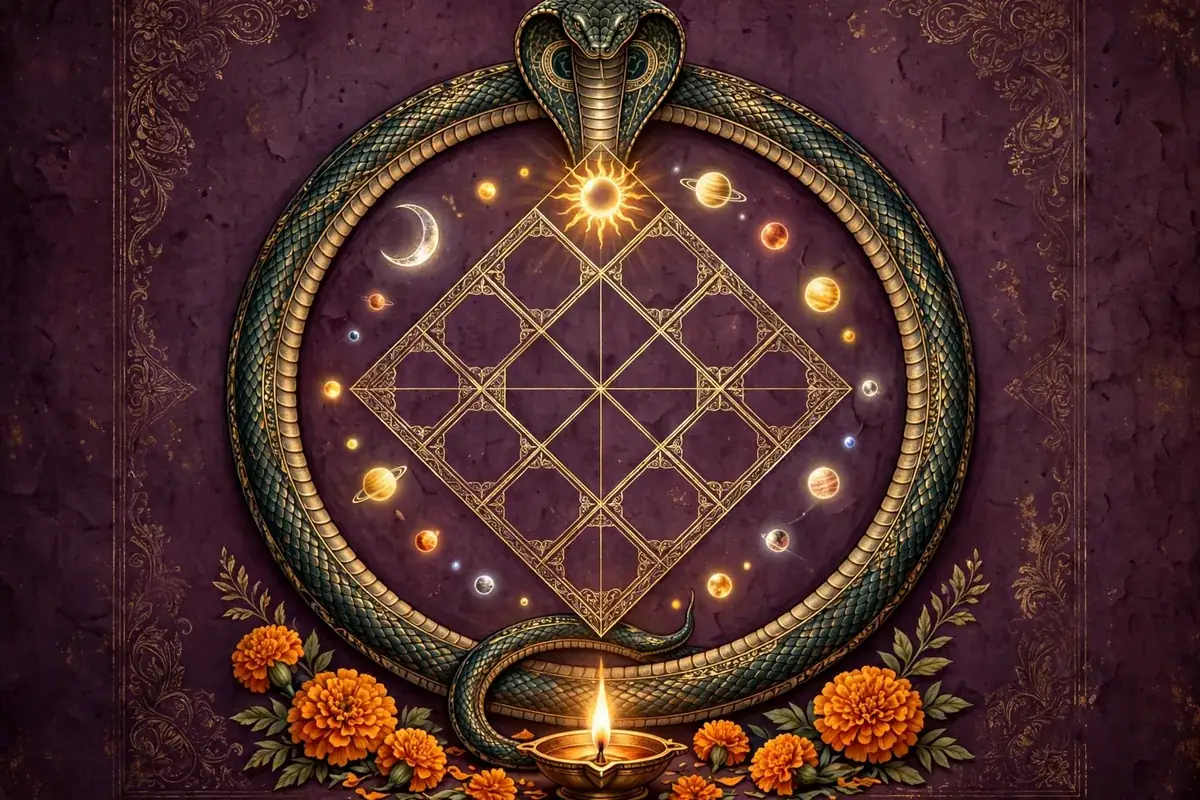
Kaal Sarp Dosh is a birth-chart (kundli) pattern where all seven planets — Sun, Moon, Mars, Mercury, Jupiter, Venus and Saturn — sit on one side of the Rahu–Ketu axis. To check yours in one minute: find Rahu and Ketu, draw the line between them in your mind, and see whether every planet falls inside that one half. One planet outside, and the full pattern is not formed. The type is named by Rahu's house — 1st house is Anant, 7th is Takshak — through the 12 types below.
What this pattern actually is
Rahu and Ketu are not physical planets. They are the two points where the Moon's path crosses the Sun's path, and eclipses happen near them. In every chart they sit exactly opposite each other, six houses apart, so together they cut the kundli into two halves with one straight axis.
Tradition pictures this axis as a great serpent: Rahu is the head, Ketu is the tail. When all seven planets gather between the head and the tail, the old image is of planets held inside the serpent's body. That picture is where the name comes from — Kaal (time) and Sarp (serpent). Many astrologers call the same pattern Kaal Sarp Yoga instead of Dosh; the chart pattern is identical, only the word changes.
Three things follow from the definition itself, and they matter more than any prediction:
- The pattern is set at birth. It does not arrive in a bad year and it does not expire in a good one. What changes over a lifetime is which dasha (planetary period) is running, and tradition reads the pattern as more or less active in different dashas.
- It is common. Any chart has some chance of holding all seven planets on one side of an axis, so a large share of the charts an astrologer sees show the full or partial pattern.
- It is one pattern among hundreds in a chart. The strength of the planets inside it, the Lagna, and the dasha sequence all change how a chart is read. No honest reading rests on this one pattern alone.
How to check your kundli, step by step
You need your birth chart — the D1 (Rashi) chart made from your birth date, exact time and place. A free chart from any standard Jyotish software or website is enough for this check, as long as it shows Rahu and Ketu.
1. Find Rahu and Ketu. Note the house each one sits in. They will always be exactly opposite — if Rahu is in the 4th house, Ketu is in the 10th. 2. Split the chart at the axis. The Rahu–Ketu line divides the twelve houses into two sets of six. Pick the half that runs from Rahu forward to Ketu through the zodiac. 3. Place the seven planets. List where Sun, Moon, Mars, Mercury, Jupiter, Venus and Saturn sit, house by house. 4. Count what is inside. If all seven planets are inside the same half — between Rahu and Ketu, with none outside — the full Kaal Sarp pattern is present. 5. Name the type. Read the house Rahu occupies and match it in the table below. Rahu's house gives the name; Ketu is always six houses away. 6. Check the edge cases before you conclude. Read the partial-pattern notes under this list — a near-miss chart is read differently by different traditions.
The hemmed-in rule, stated plainly: every planet must be between the two nodes, on the same side. One planet outside the axis — even by one house — breaks the full pattern. There is no "almost full" in the strict definition, though softer readings exist, as the next section explains.
Full, partial, or not present — the honest worksheet
Astrologers do not all draw the border in the same place. These are the three situations you will meet, and what each is usually called:
| What your check shows | Common name | How it is usually read |
|---|---|---|
| All 7 planets between Rahu and Ketu, none touching a node | Full Kaal Sarp | The complete pattern; type named by Rahu's house |
| All 7 inside, but one planet sits in the same house as Rahu or Ketu, or one planet is just outside by degree | Partial (Anshik) Kaal Sarp | Many traditions read it as a weaker form of the same pattern; some strict schools do not count it at all |
| One or more planets clearly outside the axis | No Kaal Sarp | The pattern is not formed, whatever else the chart holds |
Two border questions cause most of the disagreement:
- Same house as a node. If a planet shares a house with Rahu or Ketu, some schools count it as inside (it has not escaped the serpent), others treat the conjunction as a break. The planet's exact degree settles it in the stricter, degree-based reading: a planet a few degrees past Rahu, on the far side, is outside.
- Signs versus degrees. The simple house-count check above is the one most people use. A stricter check compares degrees along the arc from Rahu to Ketu. The two checks agree on clear cases and differ only on near-misses — which is exactly why two astrologers can give you two answers about the same chart, with both following a real method.
If your chart is a near-miss, the calm position is this: note which reading your family tradition follows, and do not pay anyone to frighten you about the difference.
Upay Pitara — Free Sample
Three full remedies from the Upay Pitara library — Shani Shanti, Nazar Suraksha and Karz Mukti — with the complete step-by-step method. Free, in exchange for your name and email.
Get the Free SampleThe 12 types, in one table
The type is named after a serpent, and the name comes only from Rahu's house. The "traditional focus" column is the life area tradition links with that axis — a theme for reflection, not a prediction and not a verdict on any person.
| Type | Rahu in | Ketu in | Traditional focus |
|---|---|---|---|
| Anant | 1st house | 7th house | Self, personality and health habits; balance with partnerships |
| Kulik | 2nd house | 8th house | Family, wealth and speech; handling sudden change |
| Vasuki | 3rd house | 9th house | Courage, effort and siblings; fortune built by one's own work |
| Shankhpal | 4th house | 10th house | Home, mother and property; standing at work |
| Padma | 5th house | 11th house | Children, education and creative work; gains and friendships |
| Mahapadma | 6th house | 12th house | Rivals, debts and daily health; expenses and rest |
| Takshak | 7th house | 1st house | Marriage and partnerships; the self inside them |
| Karkotak | 8th house | 2nd house | Sudden change and inheritance; family resources |
| Shankhchud | 9th house | 3rd house | Fortune, father and higher learning; steady daily effort |
| Ghatak | 10th house | 4th house | Career and public standing; peace at home |
| Vishdhar | 11th house | 5th house | Income and networks; children and learning |
| Sheshnag | 12th house | 6th house | Expenses and foreign places; rest, routine and letting go |
This mapping was cross-checked on 10 November 2026 against several independent published tables, and they agree on every house pairing. The only differences between sources are spellings — you will also see Shankhchud written as Shankhachud, and Padma as Padam. Spelling varies; the axis does not.
One caution about the table: the type names the axis, nothing more. Two people with Takshak can have completely different charts, because the seven planets inside the pattern, their signs and strengths, and the running dasha are all different. Any reading that stops at the type name has not really read the chart.
What Kaal Sarp Dosh is NOT
This section is the one most websites skip, and it is the most useful part of this article.
It is not named in the oldest classical texts. Kaal Sarp Dosh does not appear in the Brihat Parashara Hora Shastra, the Brihat Jataka, Saravali or Phaladeepika — the foundational books of Vedic astrology. It is a later idea that became widely popular in modern practice. Honest practitioners say this openly; it does not make the pattern meaningless to the families who observe it, but it does mean no one should present it to you as an ancient, unquestioned law.
It is not a curse, and it is not rare. A pattern that shows up, fully or partly, in a large share of all charts cannot by itself explain one person's difficulties. Charts carrying this pattern belong to people in every kind of life, including highly successful public lives — a fact astrologers who check at scale point out regularly. If the pattern alone decided outcomes, that spread would be impossible.
It does not override the rest of the chart. A strong Lagna, well-placed planets, and supportive dashas are read together with it. Traditions also hold that the pattern is felt more in Rahu, Ketu or Shani periods and less at other times — which is why the same chart can have quiet decades and demanding ones.
It is not a reason to buy anything out of fear. If a reading of your chart ends in pressure — an urgent expensive puja, a gemstone you must buy this week, a deadline for your own good — that pressure is a sales method, not astrology. The traditional practices below are simple, and the elaborate ones are a personal choice, never a compulsion.
Simple traditional remedies
These are the practices tradition attaches to this pattern. They are shared as cultural and religious practice — traditionally believed to pacify Rahu and Ketu — and none of them is a guaranteed result of any kind.
- Maha Mrityunjaya Mantra. The most commonly prescribed practice — regular chanting, often 108 repetitions, done calmly over a period rather than in one sitting.
- Shiva worship on Mondays. Rahu and Ketu are traditionally linked with Shiva in remedy practice. A simple Monday offering of water (and milk, if your family custom does it) on a Shiva lingam, at home or in a temple, is the household form of this.
- Kaal Sarp Shanti Puja, once, at a traditional centre. The dedicated puja is traditionally performed at Trimbakeshwar (Nashik) and at Srikalahasti — the two centres most associated with it. Families who choose it usually do it once, with a priest, without repeat bookings.
- Rahu and Ketu beej mantra chanting. Short seed mantras for the two nodes, traditionally chanted in the evening for Rahu and as prescribed by one's teacher or family practice for Ketu.
- Care of snakes and their habitats. A folk-traditional rule attached to this pattern: never harm a snake, and support its protection where you can. Nag Panchami observance sits in the same family of practice.
- A serpent pair in the home puja. Many households keep a small silver or copper pair of serpents in the puja place and offer water or milk on Nag Panchami and on Mondays — a symbolic, low-cost household practice.
- Steady charity in kind. Giving food or a blanket to someone in need, done quietly and regularly, is the form of daan most often named with this pattern — chosen because it is an action, not a purchase.
Notice what this list does not contain: no gemstone is compulsory, no metal must be worn, and no practice needs to be repeated until it works. Do the ones that fit your family's way, and leave the rest.
Related reading
The Rahu–Ketu axis is a birth-chart pattern, while Sade Sati is a moving transit — readers often confuse the two. See Sade Sati in 2026: Which Rashis Are Running It, and What Each Phase Means for the transit side, and Tulsi Vivah at Home: Date, Muhurat and the Full Step-by-Step Vidhi (2026) for this season's festival guide.
If what worries you is not a chart pattern but a heavy feeling at home — plants wilting, glass breaking, sudden arguments — that is the territory of Buri Nazar: 7 Signs at Home and the Simple Ways to Remove It, which covers the traditional home signs and the simple remedies.
Frequently asked questions
Kaal Sarp Dosh kya hota hai?
It is a birth-chart pattern in Vedic astrology: all seven planets — Sun, Moon, Mars, Mercury, Jupiter, Venus and Saturn — sit on one side of the Rahu–Ketu axis, between the two shadow points. Tradition pictures Rahu as the serpent's head and Ketu as the tail, with the planets held between them. It is also called Kaal Sarp Yoga. It is a pattern to understand, not a curse.
Kundli mein Kaal Sarp Dosh kaise dekhe?
Find Rahu and Ketu in your D1 chart. They are always opposite each other. Then check the seven planets one by one: if every one of them lies in the half of the chart between Rahu and Ketu, the full pattern is present. If one planet is outside, it is not formed. If a planet sits with a node or just outside by degree, many traditions call it partial (Anshik). The type is read from Rahu's house — see the 12-type table in this article.
Kya Kaal Sarp Dosh ke 12 prakar hote hain?
Yes — twelve, one for each house Rahu can occupy, each named after a serpent: Anant (Rahu 1st), Kulik (2nd), Vasuki (3rd), Shankhpal (4th), Padma (5th), Mahapadma (6th), Takshak (7th), Karkotak (8th), Shankhchud (9th), Ghatak (10th), Vishdhar (11th) and Sheshnag (12th). Ketu always sits in the opposite house. The type names the axis and its traditional theme; it does not decide the reading on its own.
Partial (Anshik) Kaal Sarp Dosh kya hota hai?
A near-miss form: all seven planets are inside the Rahu–Ketu half, but one planet is conjunct a node, or sits just outside the axis by a few degrees. Many traditions read Anshik as a weaker version of the pattern; stricter, degree-based schools do not count it as Kaal Sarp at all. Both positions exist in real practice, which is why two astrologers can answer differently about the same chart.
Kya Kaal Sarp Dosh classical grantho mein varnit hai?
No — honestly, it is not found in the oldest classical texts such as the Brihat Parashara Hora Shastra or the Brihat Jataka. It is a later concept that became popular in modern astrology. We state this openly in the article above: a practice can be widely followed and still be a later addition, and you deserve to know which one you are dealing with.
Kaal Sarp Dosh ka sabse saral upay kya hai?
Tradition's simplest answers are also its oldest household ones: regular Maha Mrityunjaya Mantra chanting, Shiva worship on Mondays, and quiet charity in kind. The dedicated Kaal Sarp Shanti Puja at Trimbakeshwar or Srikalahasti is the traditional one-time step for families who want it. None of these is a guaranteed remedy — they are practices of devotion, and any practice sold to you through fear should be refused.
Read also
Buri Nazar: 7 Signs at Home and the Simple Ways to Remove It
Sade Sati Explained: Phases, Rashi and Shani Remedies
Shukra Margi 2026: Venus Direct in Virgo, 12 Rashis
Sade Sati in 2026: Phases, Rashis and What Each Means
Kaal Sarp Shanti — Kaal Sarp Upay Ebook
11 traditional Kaal Sarp remedies with day, time, materials and full method, plus a simple 15-day plan. In Hindi, easy to follow step by step.
₹149
See the BookGet new guides and festival dates on email
One short email when a new article or festival guide is published. No spam, and you can unsubscribe any time.